The History of Paisley
- Mar 19
- 2 min read
Updated: 1 day ago
A Motif of Movement, Memory, and Transformation
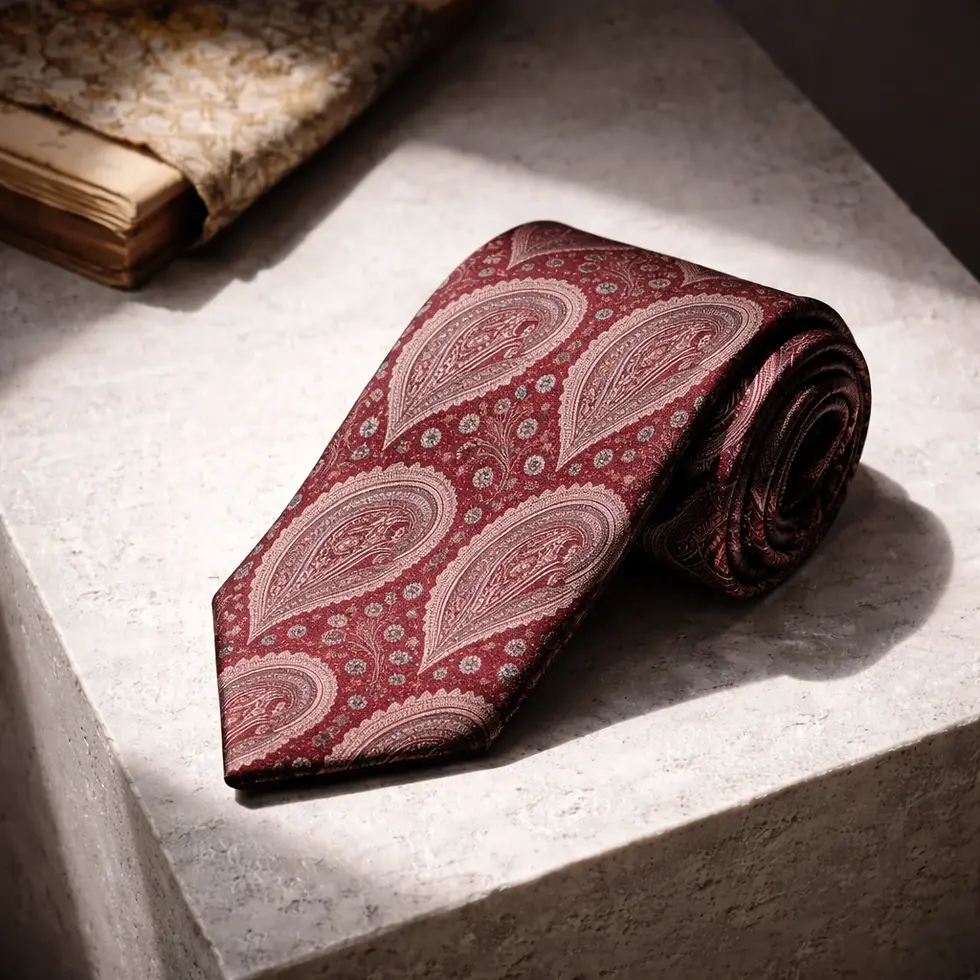
Few patterns have travelled as far—or endured as meaningfully—as paisley.
What appears today as a decorative motif is, in reality, a form of cultural memory: a shape that has crossed continents, absorbed civilizations, and continuously redefined its meaning. Paisley is not static ornament. It is movement made visible.
To understand paisley is to understand how textiles carry history—not as archive, but as living structure.
Origins — The Seed of the Motif
The paisley motif originates over two millennia ago in the ancient regions of Persia and Central Asia, where it was known as the boteh.
Its form—a curved teardrop, often described as a stylized cypress tree or a seed—held symbolic meaning:
life and growth
eternity and renewal
quiet resilience
It was never merely decorative. It was philosophical.
In these early textiles, the motif behaved like a system rather than a symbol—repeating, expanding, and flowing across fabric in a controlled rhythm.
Paisley began as geometry with meaning.
Kashmir — The Refinement of Complexity
The motif reached its most refined early expression in Kashmir, where it became central to the design of handwoven shawls.
Here, paisley evolved:
from singular symbol → to complex compositional language
from isolated motif → to integrated textile architecture
Kashmiri artisans introduced:
asymmetrical flow
dense layering
controlled repetition
The result was not pattern, but field.
The shawl became a surface of continuous movement—without beginning or end.
Europe — Transformation Through Industry
Paisley entered Europe in the 18th and 19th centuries through trade routes, where Kashmiri shawls became highly sought-after luxury objects.
In Scotland, particularly in the town of Paisley, industrial weaving techniques began to reproduce the motif at scale.
This moment marks a critical transformation:
from artisanal exclusivity → to industrial replication
from symbolic language → to decorative commodity
Yet something remained.
Even when simplified, the structure of paisley retained its internal tension—its sense of motion and expansion.
It could not be reduced entirely.
Modernity — Between Ornament and Identity
Throughout the 20th century, paisley moved through multiple cultural interpretations:
aristocratic refinement
bohemian expression
psychedelic experimentation
Each era projected its own meaning onto the motif.
But beneath these shifts, the underlying geometry persisted:
curvature against structure
flow contained within boundary
rhythm without repetition fatigue
Paisley survived because it adapts—without losing its core logic.
Paisley and tBridgeC — From Ornament to Structure
At tBridgeC, paisley is not treated as heritage decoration.
It is reconstructed.
In the Urban Paisley collection, the motif is:
disciplined
sharpened
re-timed
The softness of traditional paisley is removed.The structure is revealed.
The result:
movement becomes direction
ornament becomes architecture
history becomes present tense
Paisley is no longer nostalgic.It becomes kinetic.
The Enduring Intelligence of Form
Paisley endures because it is not fixed.
It is a system capable of transformation:
across geography
across time
across interpretation
It carries memory without being trapped by it.
This is why it remains relevant—not as revival, but as continuity.
In the language of patterns, paisley is not a motif.
It is a principle of movement.
Enter the next discipline:

Comments