The Architecture of Arabesque — How Geometry Became a Language
Updated: Sep 3
From mathematical order and infinite repetition to
a contemporary language of textile structure
THE HOUSE OF tBridgeC
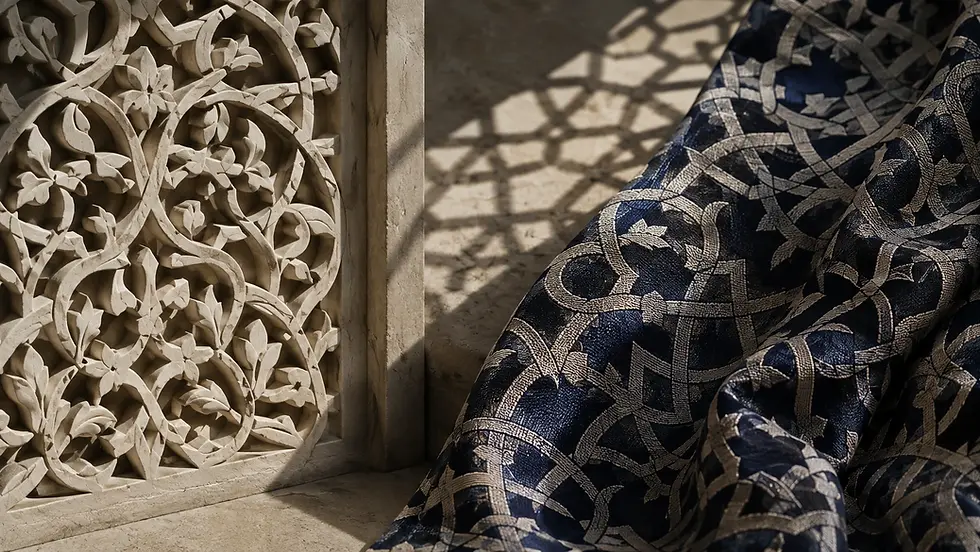
Some patterns decorate a surface.
Others organise it.
The arabesque belongs to the second category.
Across centuries, its interlacing geometries, rhythmic repetitions and abstracted vegetal forms have appeared on architecture, manuscripts, ceramics, metalwork and textiles. Yet to understand the arabesque merely as ornament is to overlook what makes it remarkable.
At its most sophisticated, the arabesque is a system.
A line becomes a curve.
A curve becomes a repetition.
Repetition establishes rhythm.
And rhythm creates structure.
The result is a visual language capable of extending beyond the boundaries of the object that contains it. This is where decoration begins to approach architecture.
The Origins of an Infinite Pattern
The word arabesque is European in origin, historically used to describe ornamental forms associated with Arab and Islamic artistic traditions. The visual language itself, however, emerged from a far more complex history.
Across the Islamic world, artists and craftsmen absorbed and transformed influences from Byzantine, Roman, Persian and other artistic traditions. Existing vegetal forms — leaves, vines, stems and flowers — were progressively abstracted, repeated and reorganised.
What emerged was not simply a new decorative vocabulary.
It was a different way of thinking about the surface.
Rather than placing a single dominant image at the centre of a composition, arabesque structures could expand across walls, ceilings, pages and objects through continuous repetition.
The individual motif became less important than the system connecting it.
And within that system lay one of the arabesque's most powerful characteristics:
the suggestion of infinity.
A pattern could theoretically continue beyond the visible boundary.
The frame stopped the material.
It did not necessarily stop the idea.
When Nature Becomes Geometry
One of the fascinating characteristics of arabesque is the relationship between the organic and the mathematical.
Its forms frequently originate in nature.
Leaves curl.
Stems divide.
Vines intersect.
Flowers unfold.
Yet nature is rarely reproduced literally.
Instead, it is disciplined.
Organic forms are simplified, mirrored, rotated and repeated until they become part of a larger geometric order.
The leaf is no longer merely a leaf.
It becomes a structural element.
This transformation is fundamental.
Arabesque demonstrates that abstraction does not require abandoning nature. It can instead reveal another order within it — one governed by proportion, rhythm and repetition.
The apparent freedom of the curves exists inside an underlying discipline.
What looks spontaneous is often carefully constructed.
And that tension between movement and control is precisely what gives the arabesque its enduring visual energy.
Geometry as an Invisible Framework
Behind many complex arabesque compositions lies something remarkably rational.
A grid.
Circles, polygons, axes, repetitions and symmetrical relationships establish an underlying framework from which increasingly complex forms can develop.
The viewer may never consciously perceive this geometry.
But the eye senses its order.
This distinction matters.
Structure does not always need to announce itself.
Sometimes its role is simply to create coherence.
Architecture operates in much the same way. A building may reveal its structural logic openly, or conceal it beneath its surfaces, but proportion and construction continue to determine how the whole is experienced.
Arabesque applies a similar principle to pattern.
Its visible complexity is held together by an invisible architecture.
Without that architecture, repetition becomes noise.
With it, complexity becomes order.
The Discipline of Repetition
Repetition is often misunderstood.
Repeating an element can easily become monotonous. Yet sophisticated repetition does precisely the opposite: it establishes rhythm.
Music understands this.
Architecture understands it.
Textiles understand it.
Arabesque does too.
A motif returns, but its relationship with neighbouring forms changes the way it is perceived. Lines intersect. Curves answer one another. Positive and negative spaces alternate. Density expands and contracts.
The eye moves.
This is why the arabesque can appear simultaneously stable and dynamic
The underlying geometry provides order.
The repetition creates movement.
Neither dominates completely.
The composition exists in the tension between the two.
The Intelligence of Negative Space
Perhaps one of the less obvious lessons of arabesque lies not in the forms themselves, but in the spaces between them.
As lines intersect and motifs repeat, empty areas become active participants in the composition.
The void acquires shape.
This is one of the fundamental principles of sophisticated design: what is absent can be as important as what is present.
Without sufficient space, complexity becomes congestion.
Without structure, ornament becomes excess.
The arabesque demonstrates that richness does not necessarily require accumulation.
Complexity can emerge from the disciplined relationship between relatively few elements.
It is a principle closely related to restraint.
Not simplicity for its own sake.
But control.
Light Changes the Pattern
Arabesque becomes particularly compelling when it leaves the page and enters architecture.
Carved stone, plaster, wood, metal and ceramic surfaces introduce another dimension: relief.
Now the pattern does not depend solely upon line and colour.
It interacts with light.
A carved surface produces shadow. As illumination changes throughout the day, those shadows move. Elements become visible and disappear again. Depth appears where previously there was only geometry.
The pattern is no longer completely static.
The architecture participates in its perception.
This relationship between structure, material and light is essential because it demonstrates something that becomes particularly relevant when arabesque enters textiles:
a pattern does not need stronger colour to become more expressive.
It can acquire presence through relief, density and shadow.
From Architecture to Textile
When a geometric language moves from stone to silk, the material changes — but the structural question remains.
How can a pattern exist as more than an image placed upon a surface?
Printing offers one answer.
Weaving offers another.
In jacquard weaving, pattern can be created through the construction of the textile itself. Different interlacements of warp and weft influence reflection, texture, density and relief.
Geometry can therefore become material.
A line may catch light differently from the field surrounding it.
A repeated form may become visible through a subtle change in weave structure rather than through a dramatic change of colour.
Movement reveals what stillness conceals.
The textile changes as the wearer moves and as light passes across its surface.
Here, the historical logic of arabesque encounters a distinctly contemporary textile possibility
The pattern is no longer simply represented.
It is constructed.
From Arabesque to Urban Arabesque
This distinction is central to the way tBridgeC approaches Urban Arabesque.
The objective is not to reproduce historical arabesque ornament.
Nor is it to imitate architectural decoration from another period or culture.
The intention is to study the principle beneath it.
What happens when geometry establishes the framework?
What happens when repetition creates movement?
What happens when negative space becomes part of the composition?
And what happens when material and light are allowed to reveal structures that colour alone cannot express?
Urban Arabesque takes these questions into a contemporary context.
The curves become more controlled.
The geometry becomes more architectural.
Historical ornament gives way to structural abstraction.
What remains is the underlying intelligence of the arabesque: the ability to create complexity through order.
This is why Urban Arabesque belongs to The Architect.
The Architect does not begin by decorating the surface.
The Architect establishes the structure from which the surface can emerge.
When Ornament Becomes Architecture
The history of arabesque ultimately raises a larger question.
When does ornament stop being decoration and become architecture?
Perhaps the answer lies in structure.
Decoration can be added.
Architecture must be organised.
When every line belongs to a larger system, when repetition establishes rhythm, when empty space carries meaning, and when material and light participate in the composition, pattern begins to behave differently.
It acquires logic.
It acquires depth.
It acquires presence.
Centuries before contemporary design began speaking about systems, modularity and generative geometry, the arabesque had already demonstrated the extraordinary possibilities of structured repetition.
Its enduring relevance therefore lies not simply in its beauty.
It lies in the intelligence behind that beauty.
The arabesque reminds us that complexity need not mean excess.
That repetition need not mean monotony.
That geometry need not mean rigidity.
And that ornament, when governed by structure, can become something more.It can become a language.
At tBridgeC, this principle finds a contemporary textile expression: geometry is not applied to the material. It is allowed to become part of its architecture.
Continue Your Exploration
Why does geometry define the tBridgeC concepts?
How can geometry become part of the textile itself?
How does tBridgeC reinterpret Arabesque today?

Comments